
Hip ultrasound in Pozzallo
Hip ultrasound performed personally by the radiologist, by appointment, at the practice in Pozzallo (RG), Italy. Report and explanation at the end of the scan.
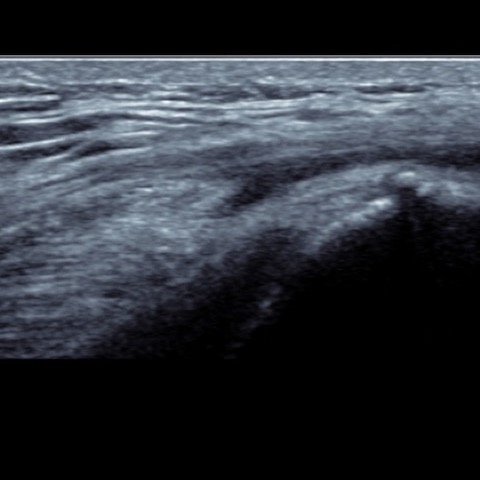
What it is for
Assesses the peri-articular tendons (gluteal, iliopsoas), the trochanteric bursae and the soft-tissue structures of the hip in adults. Useful for trochanteric tendinopathy, bursitis, groin or lateral hip pain and post-trauma follow-up.
Why it is done
Your doctor requests it for pain on the side of the hip, often linked to the gluteal tendons or the trochanteric bursa, or for groin pain linked to the deeper tendons (iliopsoas or adductors). It is also useful if you feel a snap or click when walking, after a trauma, or for discomfort that started with sport, for example running or football. It is also used to check the soft tissue around a hip replacement already in place. It is not the right exam to study the bone or the cartilage of the joint: for hip arthritis your doctor will more often use an X-ray.
How it works
You lie on the couch. I apply gel to the groin, the side of the hip or both, depending on where it hurts: sometimes I ask you to turn on your side or lie face down, so I can see the back of the hip well too. If a snapping hip is suspected, I ask you to move your leg while I watch the screen, to see how the tendon behaves. The scan is painless and usually takes 15–20 minutes.
What I check
We assess the gluteal tendons and the trochanteric bursa on the side, the iliopsoas and adductor tendons in the groin, and any fluid in the hip joint. If you have a hip replacement, we also check the soft tissue around the implant. We cannot see the bone in depth or the joint cartilage well: X-ray or MRI remain more suitable for those.
Is any preparation needed?
No. This scan needs no fasting and no preparation. If you have previous reports or scans, bring them with you: they help to compare and follow any change over time.
How much it costs
A single fee of €80 for every exam: includes the scan, the written report handed to you straight away and a spoken explanation. See fees
Frequently asked questions
I have pain on the side of my hip: is ultrasound useful?
Yes. Pain on the outer side of the hip, around the greater trochanter, is called greater trochanteric pain syndrome. Ultrasound assesses the gluteus medius and gluteus minimus tendons and the trochanteric bursa: the cause is often a tendinopathy (overload damage of the tendon) rather than bursitis.
Is it the same as the newborn hip ultrasound?
No. In adults the tendons, bursae and soft tissues around the joint are studied. In newborns the shape of the joint itself is assessed, to detect developmental dysplasia of the hip: it is a different exam, with its own page.
Will I have to move my leg during the scan?
Sometimes, yes. As well as scans at rest, a dynamic assessment, during movement of the hip, may be needed to see how the tendons glide. The probe is placed on the groin, on the side of the hip or both, depending on where the pain is.
I have a hip replacement: can I still have an ultrasound?
Yes. Ultrasound uses no radiation and can assess everything lying over the prosthesis: tendons, muscles, bursae and any fluid collections. The metal surface of the prosthesis, like bone, reflects the ultrasound beam, so what lies beyond it cannot be seen, but everything more superficial is visible.
Can ultrasound see hip arthritis?
It is not the best exam for that. Arthritis mainly involves the bone and cartilage of the joint, which are better seen with an X-ray. Ultrasound is instead useful for the tendons and soft tissue around the hip, and for any fluid in the joint.
Can ultrasound see fractures?
Ultrasound shows tendons, muscles, ligaments and the surface of the bone well, but not the inside of the bone. If a fracture is suspected, the first exam is usually an X-ray.
Why is the side that does not hurt sometimes checked too?
Because comparing with the healthy side helps to tell whether a difference is significant. If needed I do it during the same appointment, at no extra cost.
Does it hurt?
No, ultrasound does not hurt. It is a painless exam: the probe glides over the skin with a little gel. In some cases the pressure of the probe may cause slight discomfort, for example on an area that is already inflamed, on a very full bladder or on a painful joint. In rare situations, such as appendicitis, the scan may be more uncomfortable, but these cases are rare and the pressure is adapted to what you can tolerate. If you feel pain, tell me: we stop straight away.
How long does a hip ultrasound take?
About 15–20 minutes, with views over the groin and the side of the hip; up to 30 in complex cases.
What should I wear? Should I avoid creams?
Avoid creams on the hip and groin on the day of the scan. Wear comfortable clothes, for example trousers with an elastic waist, that let you uncover the hip and groin easily.
Related scans
See all the ultrasound scans available or read about the practice and contact details.
This information describes the scan in general terms and does not replace your doctor’s advice. To find out which exam suits your case, ask your doctor or contact me.
Would you like to book this scan?
Online in a few steps, or by phone. By appointment in Pozzallo (RG), Italy.
Book online